
In the rapidly evolving landscape of enterprise technology, the transition to Artificial Intelligence is often halted not by a lack of capability, but by the complexity of integration and the fear of unpredictable costs. The shift from a fragmented vendor environment to a cohesive, self-hosted ecosystem requires a fundamental restructuring of how IT leaders approach system architecture and procurement.
This tutorial explores the architectural philosophy behind the Visual Paradigm AI Ecosystem. By moving away from “patchwork” solutions that rely on multiple disconnected vendors, we can achieve a state of Total Solution integrity. We will deconstruct the components of this self-hosted architecture, understanding how Software, Setup, Training, and Support form a unified layer of value for the enterprise.
1. The Architecture of a “One Line Budget”
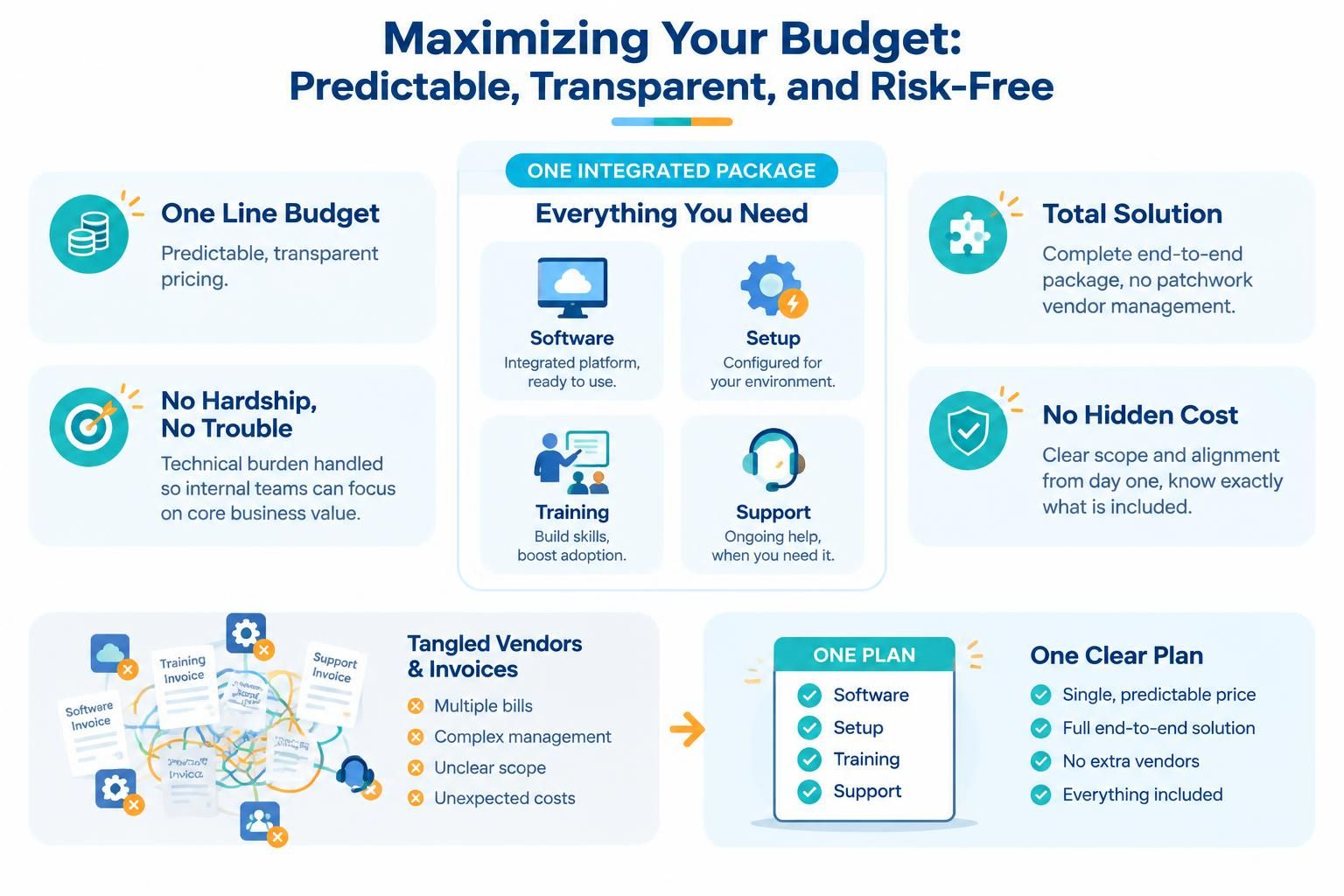
The most significant architectural flaw in many legacy enterprise systems is the separation of concerns between the tool itself and the ecosystem that sustains it. When an organization purchases software without bundling the necessary setup, training, and support, they create a “shadow architecture” of technical debt. This results in a “Tangled Vendors & Invoices” scenario, where management overhead increases while core business value stagnates.
The Visual Paradigm approach replaces this complexity with a One Line Budget. This is not merely a pricing strategy; it is a system design choice that encapsulates the entire lifecycle of the solution into a single, transparent contract. By aligning the software licensing with the human and technical resources required to deploy it, the architecture eliminates the hidden costs often associated with enterprise AI adoption.
- Software: The core engine, an integrated platform designed for immediate use.
- Setup: The configuration layer, ensuring the environment is tailored to your specific infrastructure.
- Training: The human interface layer, designed to boost adoption and skill acquisition.
- Support: The maintenance layer, providing ongoing assistance when needed.
2. The Self-Hosted Ecosystem Model
For enterprises prioritizing data sovereignty and security, the Self-Host AI Total Solution is the architectural standard. Unlike cloud-only models where data traverses public networks, a self-hosted architecture allows the organization to maintain complete control over the AI ecosystem’s perimeter.
This architecture operates on the principle of “No Hardship, No Trouble.” The technical weight of maintaining the infrastructure, updating the AI models, and managing the security protocols is shoulder by the provider. This allows internal teams to focus strictly on the core business value rather than the underlying plumbing of the system.
By visualizing this ecosystem as a single, integrated unit, we can see how the “Total Solution” eliminates the friction of vendor management. Instead of managing a software license, a separate hosting contract, a distinct training provider, and a support ticket system, the enterprise manages a single, cohesive solution package.
Key Architectural Components
The diagram of the Visual Paradigm AI Ecosystem highlights the transition from a chaotic state to an organized, efficient state.
The Transition: From Tangled to Clear
In the traditional model, organizations often face Multiple Bills and Complex Management. This fragmentation leads to unclear scope and unexpected costs. The architecture below illustrates the shift to a One Clear Plan:
- Single, Predictable Price: The financial model aligns with the technical model, ensuring transparency.
- Full End-to-End Solution: Every layer of the stack is accounted for.
- No Extra Vendors: Reducing the attack surface and management overhead.
- Everything Included: A comprehensive scope that eliminates the “unknown unknowns.”
3. Implementation Strategy: Kickstarting AI Adoption
Implementing a self-hosted AI ecosystem is a strategic initiative that requires a clear roadmap. The Visual Paradigm solution package is designed to facilitate this journey by providing a complete end-to-end package. This approach ensures that the organization does not just acquire a tool, but rather adopts a capability.
The “One Plan” checklist serves as a mental model for project managers and CTOs. It ensures that no critical component is overlooked during the procurement and deployment phases. By addressing the “No Hidden Cost” concern upfront, the architecture supports a risk-free adoption strategy.
Conclusion
The journey toward AI adoption should not be a source of financial or technical anxiety. By adopting the Visual Paradigm AI Ecosystem, organizations can achieve a state of predictability and transparency. The move from a fragmented vendor landscape to a self-hosted, integrated solution empowers enterprises to innovate faster, safer, and more efficiently. With a clear scope and alignment from day one, the path to AI success is no longer a mystery—it is a structured, manageable reality.