
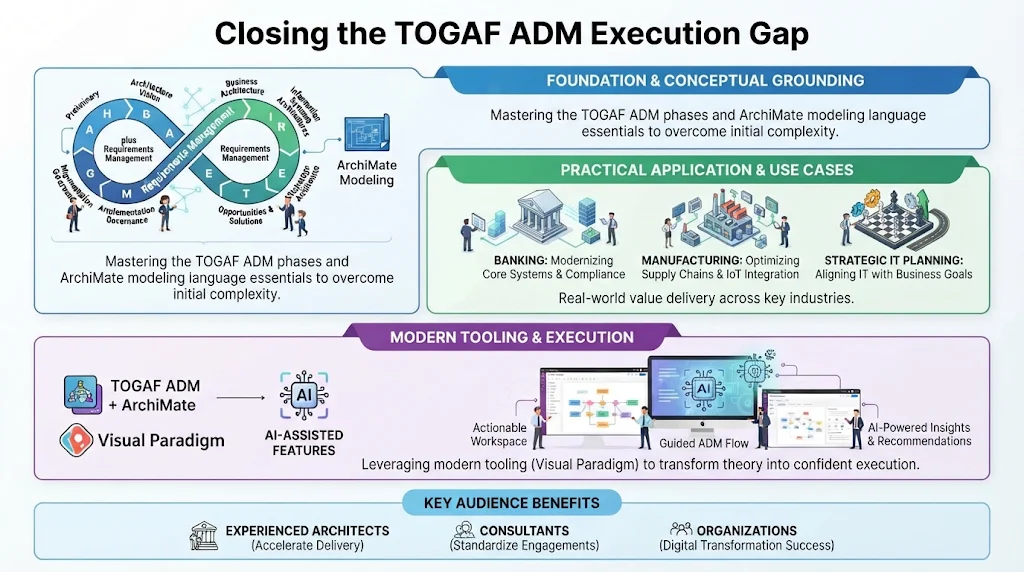
Enterprise Architecture (EA) has long suffered from a paradox: the frameworks designed to bring clarity to complex organizations are themselves notoriously difficult to adopt, learn, and sustain. While the TOGAF Architecture Development Method (ADM) remains the gold standard, many teams abandon it mid-journey, overwhelmed by the sheer volume of phases, artifacts, and governance activities it demands.
This tutorial serves as a bridge to close that gap. We will explore how modern tooling—specifically Visual Paradigm—transforms the TOGAF ADM from a theoretical reference into an actionable, navigable workspace. By integrating ArchiMate modeling and AI-assisted features, architects can move from first principles to confident execution.
1. The Foundation: TOGAF ADM and ArchiMate
Before diving into the tools, we must ground ourselves in the core concepts. The TOGAF ADM is an iterative, cyclic process designed to develop and manage the lifecycle of an enterprise architecture. It provides a step-by-step approach to ensure that the architecture aligns with business goals.
The ADM Cycle Phases
The ADM cycle guides architects from defining the scope to maintaining the architecture after implementation. The core phases include:
- Preliminary Phase: Defines the architecture capability and tailors the framework.
- Phase A (Architecture Vision): Establishes the scope, stakeholders, and high-level vision.
- Phases B, C, D (Business, Information Systems, Technology): Develop the baseline and target architectures for each domain.
- Phase E (Opportunities and Solutions): Identifies work packages and delivery vehicles.
- Phase F (Migration Planning): Creates a detailed implementation and migration plan.
- Phase G (Implementation Governance): Ensures conformance during implementation.
- Phase H (Architecture Change Management): Manages changes to the architecture.
The Role of ArchiMate
If TOGAF tells you what to do, ArchiMate provides the language to describe it. ArchiMate is an open standard modeling language that maps cleanly to the ADM phases. For example, the Business Layer supports Phase B, the Application Layer supports Phase C, and the Implementation & Migration Layer supports Phases E and F.
2. From Theory to Practice: Usage Cases
TOGAF ADM is adaptable across industries. Let’s look at how these principles translate into real-world value across key sectors.
Banking Sector Transformation
In the banking sector, organizations often face the challenge of modernizing legacy systems. A study on a major bank demonstrated using TOGAF ADM to design a Learning Management System (LMS). By applying phases from Preliminary through Opportunities and Solutions, architects produced a blueprint and roadmap that aligned employee training processes with IT capabilities, ensuring security and performance through a centralized application server and VPN.
Industrial Manufacturing Optimization
In heavy industry, the focus is often on the value chain. Case studies on manufacturing companies show how ADM can be applied to optimize end-to-end processes like Order-to-Delivery (OTD). This approach drives digital transformation by connecting physical assets with digital workflows.
Strategic IT Planning for SMEs
It is a common misconception that ADM is only for large enterprises. Research on smaller entities, such as heavy equipment rental companies, has shown that using TOGAF ADM to build a strategic IS/IT plan helps identify business needs and define an architectural vision, proving the framework’s scalability.
3. The Modern Toolkit: Visual Paradigm & Visual Process Maps
How do we make this complex framework manageable? The answer lies in Visual Paradigm, a modeling tool that integrates TOGAF ADM guidance directly into its interface.
The Visual Process Map
Visual Paradigm transforms the abstract ADM cycle into a Visual Process Map. This is a navigable flowchart where each phase and activity is a clickable node. When you open a TOGAF ADM project, you see the ADM cycle immediately. Double-clicking a phase (e.g., Preliminary) reveals the specific activities and deliverables required. Double-clicking an activity opens a workspace with instructions, sample diagrams, and action buttons to create the necessary artifacts.
Incremental Artifact Development
A standout feature of this tooling is that artifacts are reusable. A business process diagram created in Phase B automatically becomes available as a building block for gap analysis in Phase E. You do not redraw; you enrich. At the end of a phase, deliverables (like the Architecture Definition Document) can be generated with a single click.
4. The Game Changer: AI-Assisted Features
The integration of generative AI into the TOGAF Guide-Through addresses the steep learning curve and manual effort traditionally associated with ADM.
Why AI Assistance?
The primary bottleneck in ADM is often the creation of artifacts—drawing diagrams, drafting gap analyses, and building roadmaps. AI reduces this manual drafting time, allowing architects to focus on strategic decision-making and stakeholder engagement. It also lowers the barrier for organizations that lack deep TOGAF expertise, as the tool provides intelligent suggestions based on natural language descriptions.
Standout AI Capabilities
- Natural Language to ArchiMate: You can describe a scenario (e.g., “A retail digital transformation with omnichannel fulfillment”) and the AI generates a starter ArchiMate diagram illustrating the goal, capability, and realization relationships.
- Intelligent Gap Analysis: The AI can visualize the differences between baseline and target states by comparing models and highlighting missing or changed elements in editable views.
- Automated Roadmaps and WBS: For Phase E and F, the AI assists in generating work breakdown structures, transition timelines, and migration roadmaps.
- Smart Radar Charts: For maturity or capability assessments, the AI helps populate radar charts that visualize strengths and gaps at a glance.
5. Tips for Effective Execution
To get the most out of the Visual Paradigm TOGAF ADM environment, consider these practical strategies:
- Start with a Clear Narrative: Use the AI effectively by defining the scope clearly. A well-defined narrative leads to better architectural scaffolding.
- Treat AI Output as a Draft: The AI provides a structural scaffold; the architect provides the contextual nuance. Always review and refine AI-generated artifacts to ensure they align with organizational reality.
- Use the Repository as a Single Source of Truth: Visual Paradigm archives deliverables in a built-in architecture repository. Resist the urge to export and edit in external tools; keeping everything in the repository ensures traceability from requirements to implementation.
- Customize the Process Map: If your organization has a tailored ADM (e.g., integrating ITIL or agile sprints), Visual Paradigm allows you to configure the process map to reflect your specific governance gates and deliverables.
Conclusion
The TOGAF ADM is not a bureaucratic hurdle to be endured—it is a disciplined path to aligning business ambition with technological reality. Its value, however, has always depended on how well it is applied. When the framework is paired with a capable modeling language like ArchiMate and a tool that guides, rather than obstructs, the architect’s work, the ADM cycle becomes what it was always meant to be: a repeatable, transparent, and governable method for delivering change.
By leveraging Visual Paradigm’s integration of the ADM guide-through, certified ArchiMate modeling, and AI-assisted artifact generation, EA teams can reduce the manual burden of diagramming and documentation. This allows experienced architects to focus on the strategic thinking and stakeholder engagement that no tool can replace.